Introduction: The 2026 Visibility Crisis

In 2026, the local search landscape has evolved into a hyper-sophisticated, AI-driven ecosystem. We have moved far beyond the era of static directory listings. Today, search engines function as massive “Knowledge Graphs,” connecting your business’s physical location, real-time service availability, and digital reputation into a single “entity.” For a small business, local SEO is no longer a marketing “extra”—it is a strategic necessity for survival. The “visibility squeeze” is real: AI-powered search engines now filter results with extreme prejudice, prioritizing relevance and trust above all else. If you aren’t visible in the local pack, you aren’t just losing clicks; to the modern consumer, you essentially do not exist.
Part 1: The “Why”—Why Local SEO is Your Most Important Investment
The Statistics of Success
The data for 2026 is unambiguous. Local search is the primary engine of physical commerce:
-
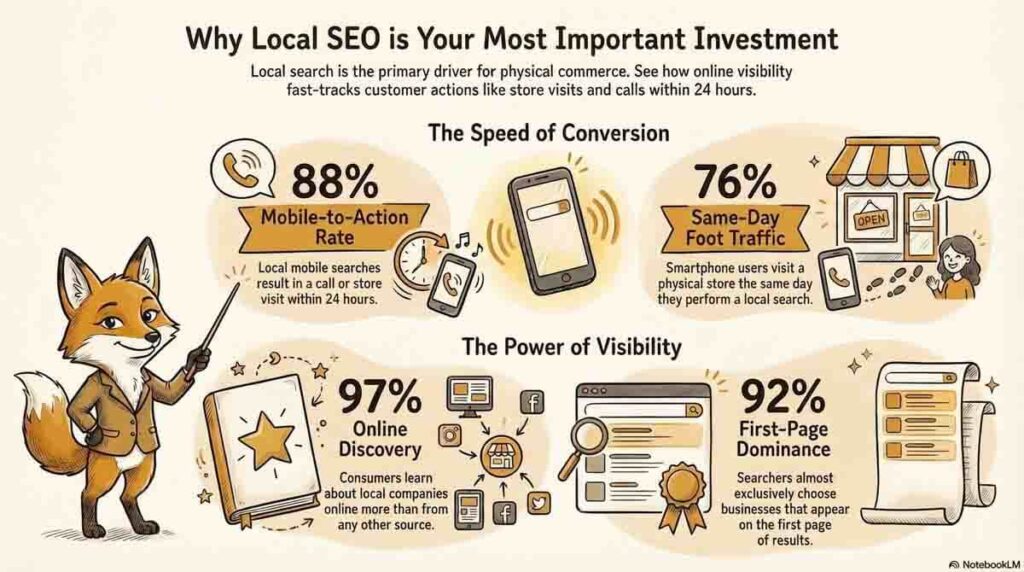
- 88% of local mobile searches result in a phone call or a store visit within 24 hours.
-
- 76% of people who search for something local on their smartphone visit a physical store that same day.
-
- 97% of consumers learn more about local companies online than from any other source.
-
- 92% of all searchers will choose a business that appears on the first page of results.
- 92% of all searchers will choose a business that appears on the first page of results.
Navigating the “AI Pack” and Zero-Click Search
The rise of AI Overviews has transformed the search results page (SERP). Currently, 58.5% of Google searches end without a single click because the AI provides the answer directly. This “zero-click” environment means your goal is no longer just a blue link—it is the Local Map Pack .However, as a strategist, I must warn you: the competition is tightening. Recent data shows that the new AI-powered local packs are surfacing only 32% as many unique businesses as the traditional 3-packs of previous years. Furthermore, Local Services Ads (LSA) and the Google Guarantee badge now occupy 31% of local-intent queries, often cannibalizing organic space. To stay relevant, your entity must be undeniable.
The Shift in Consumer Behavior
“Near me” is now inferred. Google’s algorithms are so precise that they no longer need the user to type their city. Whether a customer is searching for “emergency plumber” or “best tacos,” the AI uses real-time GPS and context to deliver results. If your optimization hasn’t accounted for this mobile-first, context-heavy reality, you are invisible to the highest-converting traffic in your neighborhood.
The Three Pillars of Local Ranking
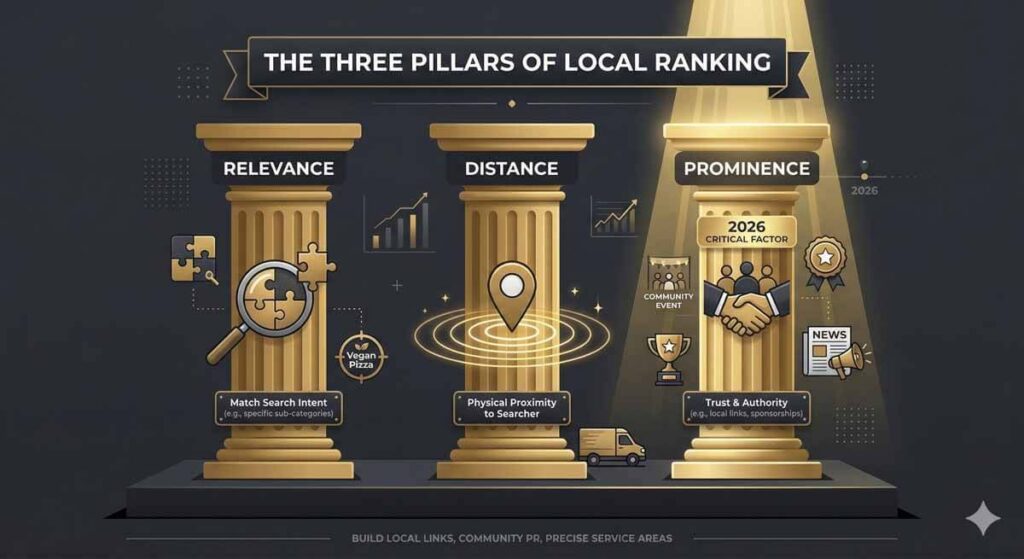
| Factor | Description | 2026 Optimization Tip |
| Relevance |
How well your business entity matches the searcher’s specific intent. |
Use specific sub-categories in your profile (e.g., “Vegan Pizza” instead of just “Pizza”). |
| Distance |
The physical proximity of your business to the searcher’s coordinates. |
Ensure your “Service Areas” are precisely defined if you are a service-area business. |
| Prominence |
The level of trust and authority your business holds across the web. |
Build local links through community event sponsorships and high-quality local PR. |
Part 2: The “How”—A Step-by-Step 2026 Roadmap
Step 1: Mastering Your Google Business Profile (GBP)
Your GBP is your digital storefront. Your absolute priority is earning a spot in the Local Map Pack.
-
- Claim and Verify: Ensure your ownership is verified via the most current Google methods (video or phone).
-
- AI-Readable Visuals: In 2026, photos are a ranking factor. Upload high-quality, 4K photos and videos weekly. Use Google Lens-optimized imagery —clear, well-lit shots of your work and storefront that AI can easily categorize.
-
- Active Engagement: Use “Google Posts” to announce promotions and updates. An active profile signals to the algorithm that your business is thriving and operational.
- Active Engagement: Use “Google Posts” to announce promotions and updates. An active profile signals to the algorithm that your business is thriving and operational.
Step 2: Absolute NAP Consistency and Advanced Citations
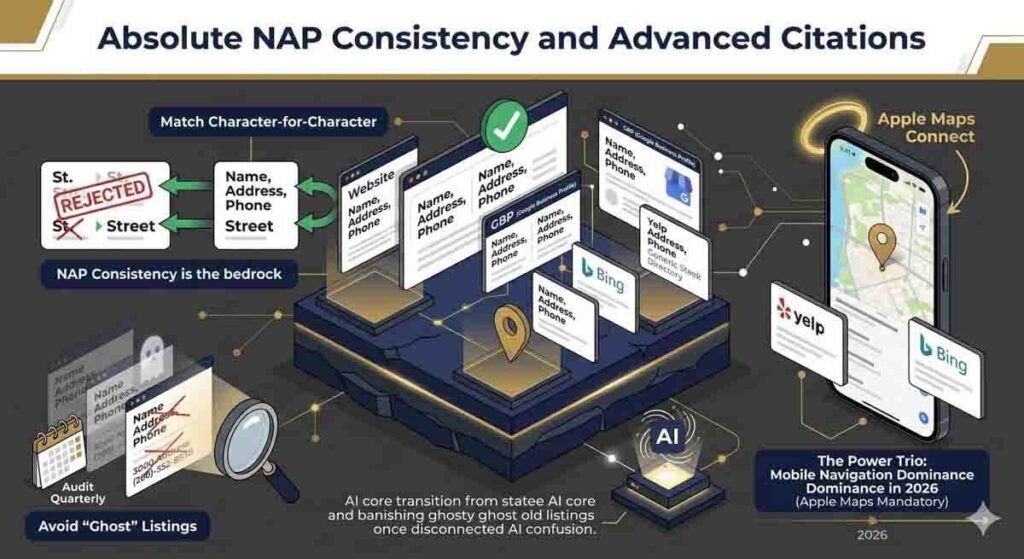
NAP (Name, Address, Phone) consistency is the bedrock of search engine trust.
-
- Standardize Everything: Your NAP must be character-for-character identical on your website, your GBP, and every directory. Avoid “St.” vs “Street” variations.
-
- The Power Trio: While Yelp and Bing are important, Apple Maps Connect is mandatory in 2026 due to the dominance of mobile navigation.
-
- Avoid “Ghost” Listings: Audit your listings quarterly to ensure old addresses or disconnected phone numbers aren’t resurfacing and confusing the AI.
- Avoid “Ghost” Listings: Audit your listings quarterly to ensure old addresses or disconnected phone numbers aren’t resurfacing and confusing the AI.
Step 3: The Review Ecosystem as a Conversion Tool
Reviews are a customer service laboratory. They don’t just help you rank; they help you sell.
-
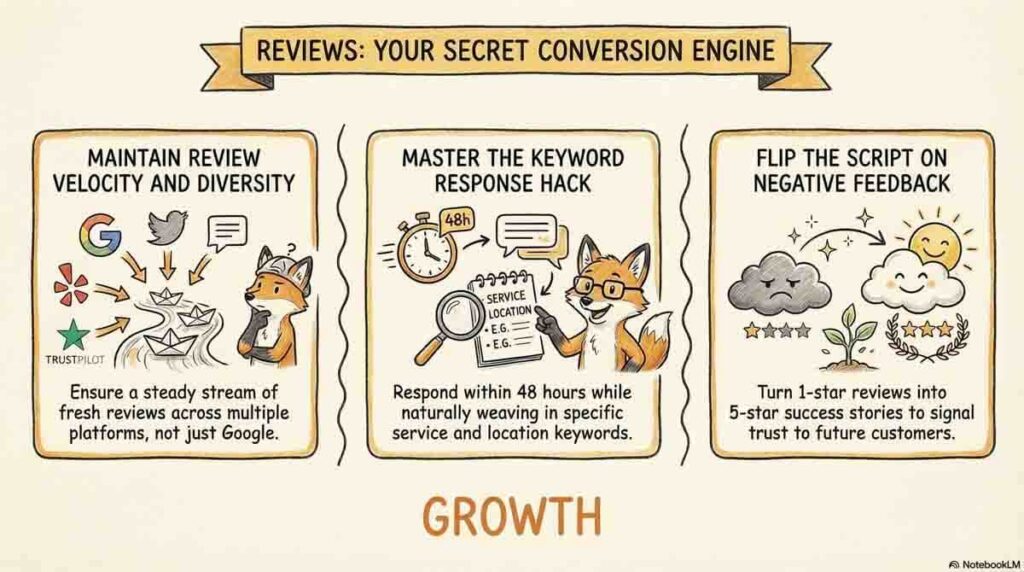
- Velocity and Diversity: You need a steady stream of fresh reviews (velocity) across multiple platforms—not just Google.
-
- The Keyword Response Hack: Respond to all reviews within 48 hours. When responding, naturally weave in service and location keywords . For example: “Glad we could help with your emergency AC repair in City Name!”
-
- Empathy and Recovery: Remember, customers love it when you solve a problem. A professionally handled 1-star review can often be turned into a 5-star success story, which is a powerful conversion signal for future customers.
Step 4: Modern Technical Foundations
Your website must serve the data that AI engines crave.
-
- Core Web Vitals: Google has transitioned fully to INP (Interaction to Next Paint) . Your site must be lightning-fast on mobile, with an INP of less than 200ms.
-
- JSON-LD Schema: Implement advanced Local Business Schema using JSON-LD. This code tells the AI exactly who you are, your pricing, and your hours.
-
- Speakable Schema: For 2026, include “Speakable” schema to ensure your content is compatible with AI voice assistants.
- Speakable Schema: For 2026, include “Speakable” schema to ensure your content is compatible with AI voice assistants.
Step 5: Locally Focused Content & User-Generated Content (UGC)
-
- Location Landing Pages: Create unique, high-value pages for every neighborhood you serve. Avoid generic templates. Include local landmarks and specific case studies.
-
- Leverage UGC: Take a cue from Starbucks’ #RedCupContest . Encourage your customers to post photos with your products and use “location tags” on social media. This user-generated content creates “local signals” that tell search engines you are a pillar of the community.
- Leverage UGC: Take a cue from Starbucks’ #RedCupContest . Encourage your customers to post photos with your products and use “location tags” on social media. This user-generated content creates “local signals” that tell search engines you are a pillar of the community.
Future-Proofing: Voice, Visual, and Hyper-Local Context
-
- Voice Search Optimization: Voice queries are conversational. Optimize by creating FAQ pages that answer long-tail questions like, “Who is the best rated plumber near me open on Sunday?”
-
- Visual Search and Google Lens: Ensure your website’s images have descriptive alt-text and that your physical signage is clearly visible in GBP photos, as visual recognition is now part of the ranking process.
-
- Hyper-Relevance: AI now considers “contextual signals”—is it raining? The AI might prioritize indoor activities. Is it late? It looks for “Open Now” status. Keep your attributes (WiFi, parking, outdoor seating) updated in real-time.
- Hyper-Relevance: AI now considers “contextual signals”—is it raining? The AI might prioritize indoor activities. Is it late? It looks for “Open Now” status. Keep your attributes (WiFi, parking, outdoor seating) updated in real-time.
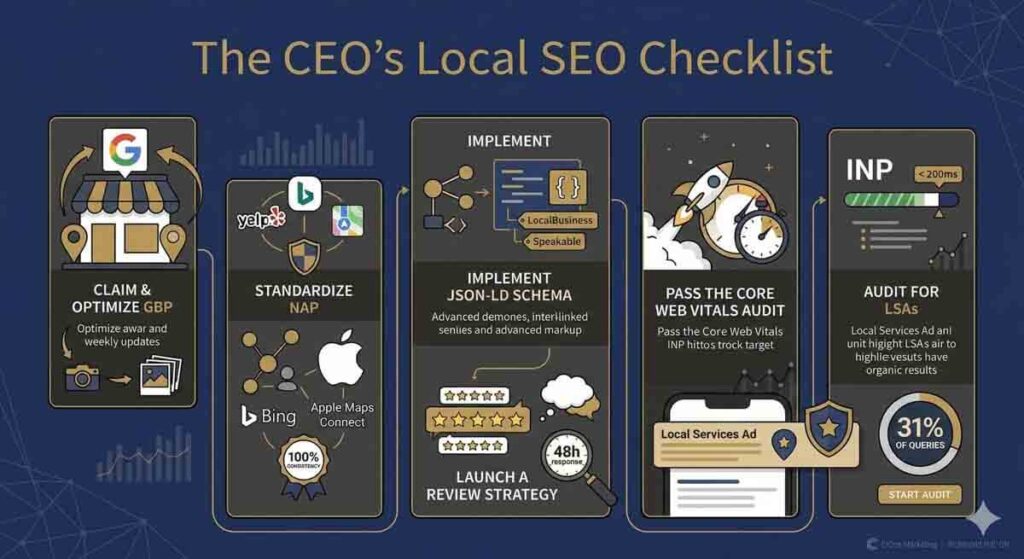
The CEO’s Local SEO Checklist
-
- Claim and Optimize GBP: Fill every field and upload high-res visuals weekly.
-
- Standardize NAP: Ensure 100% consistency across Yelp, Bing, and Apple Maps Connect .
-
- Implement JSON-LD Schema: Include “LocalBusiness” and “Speakable” markup.
-
- Pass the Core Web Vitals Audit: Target an INP of < 200ms .
-
- Launch a Review Strategy: Respond to all reviews within 48 hours using location keywords.
-
- Audit for LSAs: Determine if Local Services Ads are right for your niche to capture the top 31% of queries.
- Audit for LSAs: Determine if Local Services Ads are right for your niche to capture the top 31% of queries.
Frequently Asked Questions (FAQ)
1. What is the difference between Local SEO and Organic SEO?
Organic SEO focuses on ranking your website for general information on a broad scale. Local SEO is a specialized discipline focused on driving traffic from geographic-specific searches, specifically targeting the Local Map Pack.
2. How long does it take to see results?
While technical site changes can be indexed in days, building “Prominence” (reviews and local backlinks) typically takes 3 to 4 months to significantly move your ranking in a competitive market.
3. Do I need a physical address?
Google requires a verifiable physical address for the Map Pack. If you are a Service-Area Business (SAB) —like a locksmith or plumber—you can hide your physical address from the public while still defining the specific regions you serve.
4. Are paid directory listings worth it?
In 2026, focus on high-authority, free directories first. Paid listings are generally only worthwhile if the directory provides a high-quality “dofollow” link or significant referral traffic within a specific industry niche.
Get a Free GBP Snapshot Audit
Is your Google Business Profile actually driving calls — or just sitting there? We’ll review your listing and send you a one-page snapshot showing exactly where you’re losing visibility and what to fix first. No pitch, no fluff — just a clear picture of where you stand. Spots are limited to 5 businesses per month.