Dental Marketing Canada: A Complete Guide for 2026
Quick Answer: Effective dental marketing in Canada requires a multi-channel approach focused on Local SEO, Google Ads, and patient-centric content. Clinics that invest in local search optimization see, on average, a 35% increase in call volume from their Google Business Profile within six months. A successful strategy moves beyond simple advertising to build a predictable system for attracting high-value patients.
A successful dental marketing strategy attracts the right patients by establishing online authority and measurable trust. This guide provides a data-backed framework for Canadian dental clinics to increase new patient bookings and calculate return on investment. The goal is not just to be seen online, but to be chosen by patients actively seeking care in your community.
Competition among dental practices is significant, especially in urban centres like Toronto and Vancouver. Furthermore, patient expectations have evolved; they research procedures, compare clinics, and read reviews before making a call. Programs like the Canadian Dental Care Plan (CDCP) also introduce new patient segments and marketing opportunities. A clear, data-driven plan is necessary to navigate this environment and achieve sustainable growth.

Foundational SEO for Canadian Dental Clinics
Search Engine Optimization (SEO) is the non-negotiable foundation for any dental practice’s online presence. For a local service like dentistry, this begins with Local SEO. The objective is to achieve high visibility on Google Maps and in the “Local Pack” search results that appear when a potential patient searches for terms like “dentist Richmond Hill” or “emergency dental clinic near me.” This is critical because, according to Google data, searches containing “near me” have grown exponentially, indicating that proximity is a primary decision factor for patients.
Optimizing your Google Business Profile (GBP) is the most impactful action you can take. A complete and active profile—including accurate hours, services, photos, and consistent new patient reviews—directly influences your ranking. According to BrightLocal, 98% of consumers used the internet to find information about local businesses in 2023. Your GBP is often the first interaction a potential patient has with your clinic, making it a vital piece of digital real estate. It must be managed with the same care as your physical front office.
Beyond your GBP, on-page SEO for your clinic’s website is essential. This involves creating unique, informative pages for each core service you offer (e.g., Invisalign, dental implants, teeth whitening, sleep apnea treatment). These pages should be optimized with relevant keywords and location-specific information to signal to search engines like Google and Bing that you are the local authority for these procedures. Adherence to the advertising guidelines set by provincial bodies, such as the Royal College of Dental Surgeons of Ontario (RCDSO), is mandatory when creating this content.
High-Intent Patient Acquisition with Paid Advertising
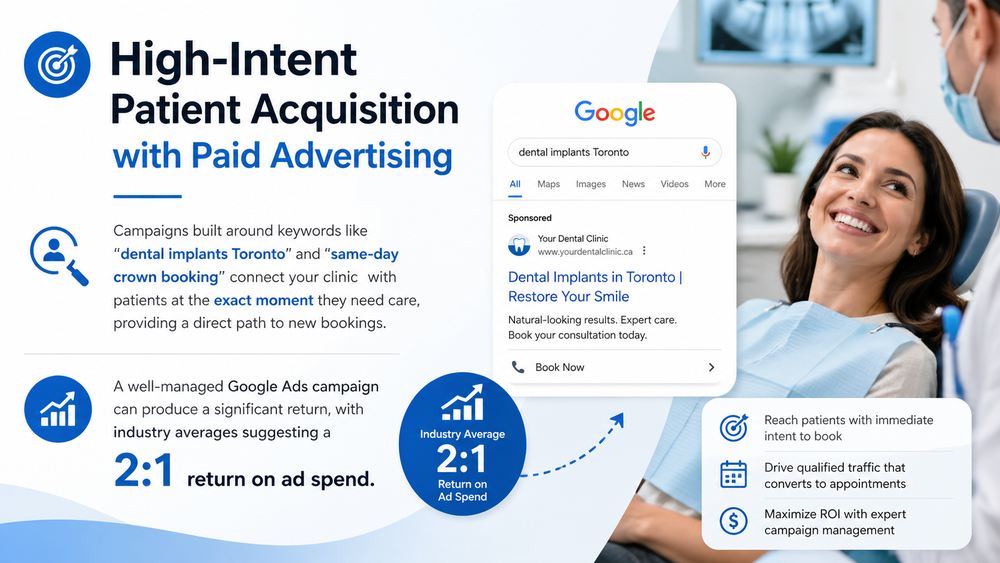
While SEO builds long-term value, paid advertising delivers immediate and targeted patient traffic. Google Ads is the primary platform for capturing high-intent patients who are actively searching for dental services. Campaigns built around keywords like “dental implants Toronto” or “same-day crown booking” connect your clinic with patients at the exact moment they need care, providing a direct path to new bookings. A well-managed Google Ads campaign can produce a significant return, with industry averages suggesting a 2:1 return on ad spend.
Meta Ads (Facebook and Instagram) serve a different but complementary purpose. While users are not typically searching for a dentist on social media, the platform’s powerful demographic and interest-based targeting allows you to build brand awareness and promote specific services. It is particularly effective for visual services like cosmetic dentistry or for reaching specific community segments, such as families in a new housing development or individuals eligible for the Canadian Dental Care Plan (CDCP). The key is to use compelling creative (images and videos) and a clear call to action.
Choosing the right platform depends on your immediate goals. For a clinic looking to fill its appointment book with high-value procedures, Google Ads is the priority. For a practice aiming to build a community presence and promote elective services, Meta Ads offer a valuable channel. A comprehensive strategy often uses both in tandem.
Feature | Google Ads | Meta Ads (Facebook/Instagram) |
|---|---|---|
Primary Intent | High (Active Search) | Low (Passive Discovery) |
Targeting | Keywords (“emergency dentist Toronto”) | Demographics, Interests, Location |
Best For | Capturing immediate patient needs (e.g., emergencies, implants) | Building brand awareness, promoting cosmetic services |
Cost Per Lead | Generally Higher | Generally Lower |
Building Trust Through Content and Reputation
In healthcare, trust is the ultimate conversion factor. Your digital marketing must actively build and maintain this trust. This is achieved through a combination of valuable content and proactive reputation management. Content marketing for dentists is not about generic blog posts; it is about answering your specific patients’ questions through detailed service pages, informative articles, and video explainers. For example, creating a comprehensive guide on what to expect during a root canal procedure, complete with a video from one of your dentists, demystifies the process and positions your clinic as a caring, authoritative source.

Reputation management involves systematically encouraging and monitoring patient reviews on critical platforms like Google, RateMDs, and Yelp. A steady stream of recent, positive reviews is one ofthe strongest signals of a healthy, patient-focused practice. A study by Software Advice found that 74% of patients use online reviews as their first step in finding a new doctor. Responding professionally to all reviews—both positive and negative—demonstrates that you value patient feedback and are committed to service excellence.
This content and reputation strategy must also be compliant with provincial regulations. Bodies like the CDA and RCDSO have specific rules about what can be said in marketing materials. All content should be factual, verifiable, and focused on patient education rather than making unsubstantiated claims. This approach not only ensures compliance but also builds genuine, long-term trust with your community.
Measuring What Matters: KPIs and ROI for Dental Marketing
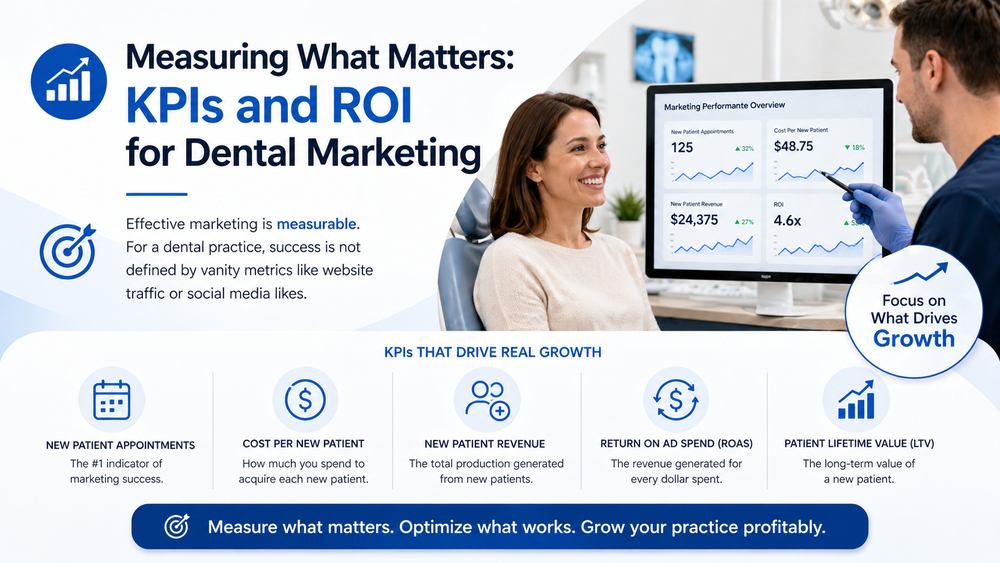
Effective marketing is measurable. For a dental practice, success is not defined by vanity metrics like website traffic or social media likes. It is defined by tangible business outcomes. The key performance indicators (KPIs) that matter are New Patient Bookings, Cost Per Lead (CPL), and Patient Lifetime Value (PLV). Tracking these metrics allows you to calculate the precise return on investment (ROI) of your marketing budget and make data-driven decisions for future growth.
To track these KPIs, your digital infrastructure must be correctly configured. This includes implementing conversion tracking through Google Analytics 4 (GA4) and your advertising platforms. Every phone call from your website or an ad, and every submission of a “Request an Appointment” form, must be tracked as a conversion. This data provides a clear line of sight from marketing spend to a new patient walking through your door. This level of tracking is possible by integrating your website with your clinic’s patient management software, such as ClearDent, Dentrix, or Jane App.
A transparent agency will provide monthly reports that focus on these core business metrics. The conversation should be about how many new patient opportunities were generated and what the cost was to acquire them. This data-first approach removes guesswork and holds your marketing efforts accountable to the only goal that matters: growing your practice profitably.
Frequently Asked Questions
How much should a dental clinic in Canada spend on marketing?
A common benchmark is 5-10% of gross revenue. New practices may invest more, up to 15%, to establish a patient base, while established clinics might be at the lower end. The key is tying the budget to specific new patient goals and calculating the expected return.
What is the most effective marketing for dentists?
For immediate results, Local SEO and targeted Google Ads for high-intent keywords like “emergency dentist” are most effective. For long-term growth, a combination of SEO, educational content, and reputation management builds a sustainable patient pipeline at a lower cost per acquisition.
Is SEO worth it for dentists in 2026?
Yes. With over 90% of consumers using search engines to find local services, a high ranking on Google Maps and organic search is critical. SEO provides a consistent flow of new patients at a lower long-term cost compared to paid advertising.
How can my clinic attract patients under the Canadian Dental Care Plan (CDCP)?
Create dedicated website pages explaining the CDCP and your clinic’s participation. Use targeted Google and Meta ads to reach eligible demographics in your service area. Ensure your front desk team is trained to answer CDCP-specific questions accurately.
Can you guarantee a #1 ranking on Google?
No agency can ethically guarantee a specific ranking on Google. Search engine algorithms are complex and constantly changing. A reputable agency focuses on transparently improving key performance indicators like qualified traffic, leads, and new patient bookings.
What are the RCDSO rules for advertising in Ontario?
The Royal College of Dental Surgeons of Ontario (RCDSO) requires all advertising to be verifiable, accurate, and not misleading. It prohibits claims of specialization without proper certification and discourages superlative claims. Always consult the latest RCDSO guidelines before launching a campaign.
Final Recommendation
For a Canadian dental clinic seeking predictable growth in 2026, the most effective strategy is to first dominate local search results. This requires a meticulous Google Business Profile optimization and a content strategy focused on your specific services and neighbourhood. Once this foundation is set, layer in a targeted Google Ads campaign focusing on 2-3 high-value procedures to generate immediate, measurable patient flow.
Schedule Your Free Strategy Call
Take the first step towards a more predictable and profitable marketing strategy. Contact CiCon Marketing to discuss your clinic’s specific growth goals.
Book your call online:
https://cicon.ca/book-a-strategy-call-with-cicon-marketing/
Or call us directly: (289) 807-1020
About the Author — Majid Behzad, Founder & Senior Digital Marketing Strategist
Majid Behzad is the founder of CiCon Marketing with over 15 years of experience in digital marketing and media production. A Google-certified specialist with a Master’s in Engineering and Postgraduate degree in Marketing Management, he delivers data-driven growth strategies for businesses across the GTA. Connect with him on LinkedIn and Instagram, or learn more at cicon.ca/about-us/.