TL;DR: Google Ads campaigns launched cold in April — at the start of the GTA trades season — pay significantly more per click because they have no Quality Score history. The 5-step pre-season setup (Quality Score building, negative keywords, call tracking, service-specific landing pages, and call-only campaigns for mobile) must be in place before April. CiCon has helped GTA trades businesses cut their cost per inbound call by setting up campaigns in March rather than reactive launches mid-season.

The GTA trades season doesn’t start when you decide to advertise. It starts when customers start searching — and in this market, that’s April. HVAC tune-up requests, roofing inquiries, landscaping bookings, and exterior renovation projects all surge in the same window. By the time you’re thinking about launching a Google Ads campaign, your competitors who planned ahead have already been building their Quality Score for six weeks.
This isn’t a warning about being early. It’s a structural argument. A Google Ads campaign launched cold in April competes at a mechanical disadvantage in every auction it enters. The businesses that started in March pay less per click for the same positions — not because they got lucky, but because Google’s algorithm rewards campaign history. This post breaks down the five setup decisions that determine your cost per lead before the season starts.
In This Post
- Why Quality Score Is a Pre-Season Asset
- Negative Keywords: The Most Preventable Budget Leak
- Call Tracking: The Metric That Actually Matters
- Landing Pages: Why the Homepage Kills Ad Performance
- Call-Only Campaigns for High-Intent Mobile Searches
- Frequently Asked Questions
Why Quality Score Is a Pre-Season Asset
Quality Score is Google’s 1–10 rating of how relevant your ad is to the search query, your expected click-through rate, and the quality of the landing page the ad points to. It’s recalculated continuously as your campaign runs. A new campaign has no Quality Score history — it starts at the baseline and earns its rating through live performance data.

This matters for cost. Google’s Ad Rank formula combines your bid with your Quality Score. A campaign with a strong Quality Score can achieve the same ad position as a competitor at a lower bid. Conversely, a cold campaign launching in April pays top-of-market CPCs while the algorithm determines whether you’re a credible advertiser. In the GTA trades niche, where CPC runs $3.50–$8.00/click during peak season, paying 20–30% more per click for 6 weeks adds up to a measurable campaign performance gap.
The practical implication: launch in March. Let the campaign earn its history — its click-through patterns, its conversion signals, its relevance signals — before the April auction gets expensive. A campaign that has been running for 6 weeks when the season peaks performs better at lower cost per lead than one launched the same week demand spikes.
According to Google’s own documentation, Quality Score components include expected CTR, ad relevance, and landing page experience. All three improve with time and data — which is exactly the advantage a pre-season launch builds.
Negative Keywords: The Most Preventable Budget Leak in Trades Google Ads
This is the mistake we see most consistently in GTA trades Google Ads accounts we audit: broad or phrase match keywords with no negative keyword list. The result is ad spend on searches that will never generate a call.

“Plumbing services” matches to “plumbing courses.” “Roofing contractor” matches to “roofing contractor jobs.” “HVAC repair Toronto” can match to “HVAC training Toronto.” Every one of those clicks costs the same as a high-intent click — and produces zero calls.
Negative keywords are the terms you explicitly exclude from triggering your ads. A comprehensive negative keyword list for a GTA trades business includes job-related terms (jobs, hiring, career, apprenticeship), DIY-related terms (how to, tutorial, DIY, manual), and geographic exclusions if the service area is limited. This list should be built before the campaign launches — not after two months of budget has been spent identifying what to exclude.
The compounding effect: irrelevant clicks don’t just waste budget. They lower your click-through rate, which degrades your Quality Score, which raises your cost per click for the relevant searches. Negative keywords protect both your budget and your Quality Score simultaneously.
Call Tracking: Managing Google Ads Without It Is Managing Blind
For GTA trades businesses, the conversion is a phone call. Not a form fill, not a website session — a booked service appointment. Call tracking is the mechanism that connects every inbound call to the specific campaign, ad group, and keyword that drove it.
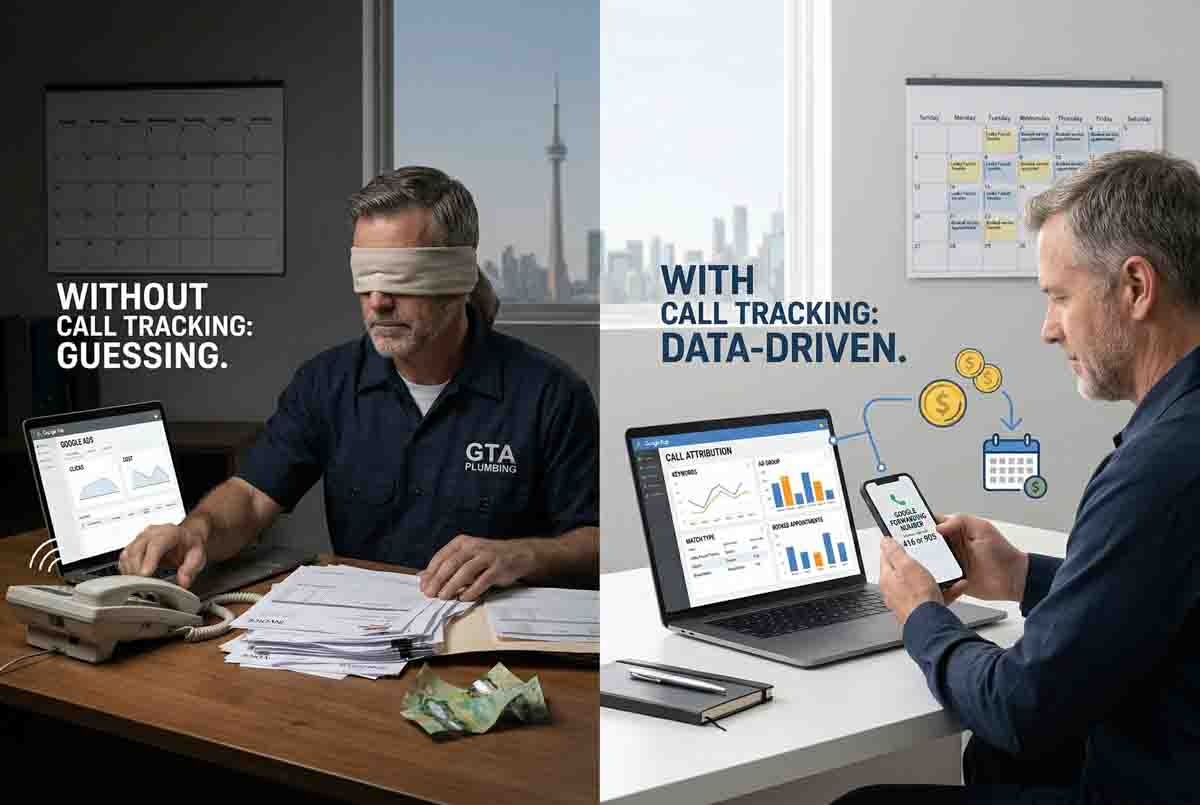
Without call tracking, you’re optimizing a Google Ads campaign without knowing which parts are working. You can see click data, impression data, and cost data — but you cannot answer the question that matters: which ad drove which call? Budget decisions made without call attribution are guesses. Budget decisions made with call attribution are data-driven optimizations.
Call tracking works by assigning unique phone numbers (either Google forwarding numbers or third-party call tracking numbers) to specific campaign sources. When a prospect calls, the system records the call and attributes it to its source. In a properly configured account, every inbound call has a campaign, ad group, keyword, and match type attached to it.
We’ve seen GTA trades businesses spending $3,000+/month on Google Ads with no call tracking in place — meaning they had no usable conversion data and were making monthly budget decisions based on click volume alone. The fix is setup work, not spend. Call tracking should be configured before the first dollar of campaign budget goes live.
Landing Pages: Why Sending Trades Ad Traffic to the Homepage Fails
The homepage is a general orientation page. It answers the question “who are you?” A search ad landing page needs to answer a different question: “can you solve my specific problem, and when can you come?”

Sending paid traffic to a homepage is the single most common landing page error in trades Google Ads accounts. The visitor arrives with high intent — they searched for “emergency plumber Richmond Hill” or “HVAC tune-up Markham” — and lands on a page that talks about the company generally, lists all services, and buries the conversion action three scrolls down. That’s friction. Friction kills conversion rate. A lower conversion rate means higher cost per lead.
The structure that works: one service-specific landing page per major service category, with a single call-to-action above the fold, a clear service description, trust signals (reviews, years in business, service area), and a phone number that’s large and clickable on mobile. The page exists to answer the prospect’s implicit question — “yes, I solve your specific problem, here’s who we are, call now.”
In Richmond Hill and across the GTA, we’ve seen conversion rate improvements of 40%+ from replacing homepage destinations with service-specific landing pages for trades campaigns. The ad spend doesn’t change. The cost per lead drops because the landing page does its job.
Call-Only Campaigns: The Highest-ROI Format for Emergency Trades Searches
A call-only campaign is a Google Ads format that appears exclusively on mobile devices and delivers a click directly to a phone call — no website visit, no landing page required. The ad includes a phone number, a headline, and a description. When someone clicks it, their phone dials your number immediately.
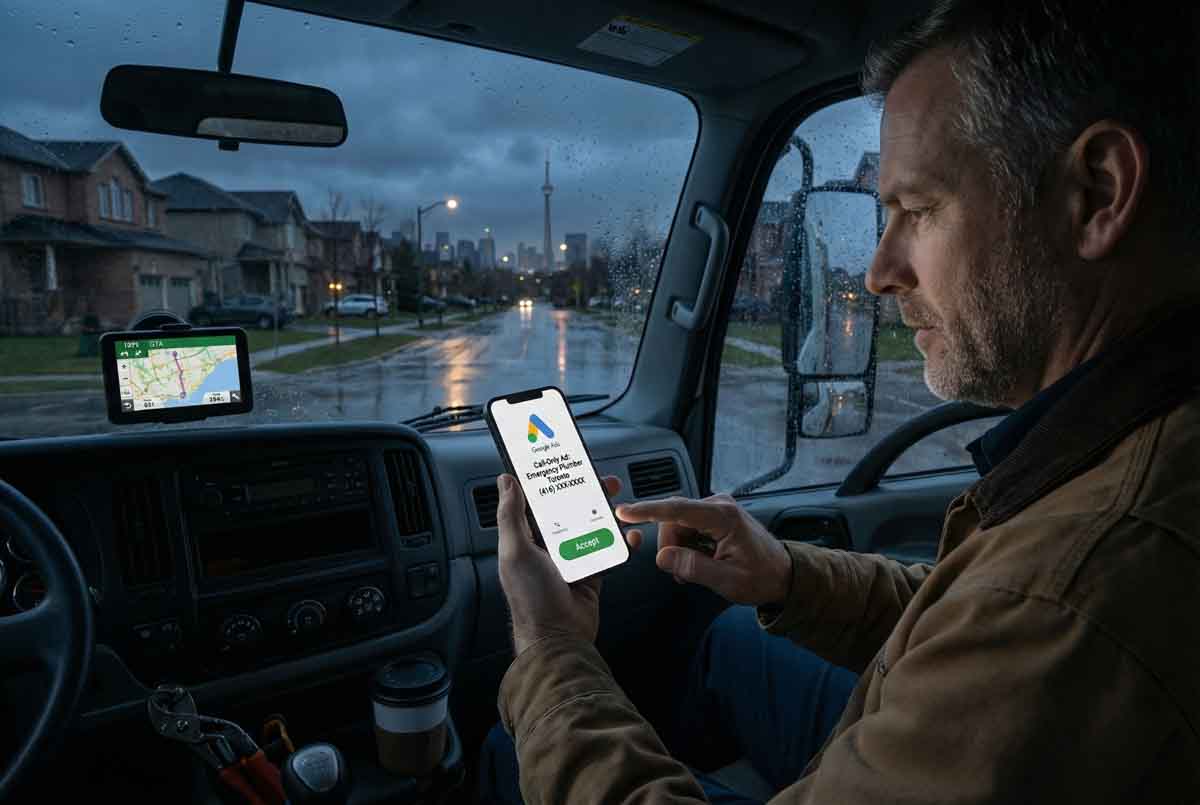
For emergency and urgent trades services — emergency plumbing, locksmith, emergency HVAC — this is the correct ad format. Someone searching “burst pipe plumber Toronto” on their phone at 11pm is not going to fill out a contact form. They’re going to call whoever answers. A call-only ad eliminates every step between the search and the call.
CPCs for call-only campaigns are typically lower than equivalent standard search ads because the format targets a narrower, higher-intent subset of searches. Conversion rates are higher because the conversion action (a phone call) is one click away. For emergency services and same-day bookings, call-only campaigns consistently deliver the lowest cost per inbound call in our GTA trades clients’ accounts.
Call-only campaigns require call tracking integration to work properly — the call tracking number is the conversion event. Which brings us back to setup: all five of these items are interconnected. Quality Score builds from properly structured campaigns with good landing pages. Negative keywords protect Quality Score. Call tracking enables data-driven optimization. Call-only campaigns maximize call volume for high-intent mobile searches. None of these are “set and forget” — but all of them must be set before April.
Frequently Asked Questions
What is Google Ads Quality Score and why does it matter for trades businesses?
Quality Score is Google’s 1–10 rating of your ad relevance, expected click-through rate, and landing page experience. A higher Quality Score means you pay less per click for the same ad position. Trades businesses that launch campaigns cold in April have no QS history and pay top CPCs while competitors with established scores pay 15–30% less for the same placements.
How much do Google Ads cost for trades businesses in the GTA?
CPC in the GTA trades niche typically runs $3.50–$8.00/click during peak season (April–June) for keywords like HVAC repair Toronto, roofing contractor GTA, and emergency plumber. Cost per inbound call — the metric that matters — varies by service category, campaign structure, and Quality Score history. Campaigns launched before peak season consistently achieve lower cost per call than campaigns launched cold in April.
What are negative keywords and why do trades businesses need them?
Negative keywords are search terms you explicitly exclude from triggering your ads. Without them, broad and phrase match keywords generate irrelevant clicks — “plumbing services” matches “plumbing courses,” “roofing contractor” matches “roofing careers.” Every irrelevant click wastes budget and degrades Quality Score. A tight negative keyword list should be built before a trades campaign launches, not after the budget has been spent.
What is call tracking for Google Ads and how does it work?
Call tracking assigns unique phone numbers to specific campaigns, ad groups, or keywords. When a prospect calls, the system records which ad drove the call. This connects every inbound phone call to its source — campaign, keyword, and ad. For GTA trades businesses, where the conversion is a booked service call, call tracking is the primary attribution mechanism. Without it, you’re managing ad spend without knowing which campaigns produce calls.
What is a call-only Google Ad and when should trades businesses use it?
A call-only ad appears exclusively on mobile devices and sends the click directly to a phone call — no website visit required. They’re the highest-ROI format for emergency and urgent trades services (emergency plumbing, HVAC repair, locksmith) because the searcher’s intent is to call immediately, not browse a website. CPCs are typically lower, and conversion rates are higher than standard search ads for these service categories.
How does CiCon manage Google Ads for GTA trades businesses?
CiCon manages Google Ads for GTA trades businesses with a seasonal-strategy approach: pre-season campaign launch (March), proper match type architecture, negative keyword lists built before spend begins, call tracking integration on every campaign, and service-specific landing pages. We report on cost per inbound call — not cost per click. The free Strategy Call is the starting point.
The Window Is March
Spring Google Ads performance isn’t determined in April. It’s determined by what you set up in March — Quality Score, negative keywords, call tracking, landing pages, and call-only campaigns for mobile. Every one of these is a setup decision, not a spend decision. Get them right and you enter peak season with a structural cost-per-lead advantage over every competitor who waited.
If your trades business isn’t running Google Ads yet, or if your current campaign was set up once and left running without these foundations, the gap is fixable — but the window to fix it before the season starts is closing. Book a free Strategy Call. We’ll audit what you have, identify what’s missing, and tell you exactly what needs to happen before April — whether you hire us or not.
About the Author
MJ is the founder and lead strategist at CiCon Marketing, a boutique digital marketing agency in Richmond Hill, Ontario. With 14+ years of experience in paid advertising, local SEO, and media production, Majid has helped 100+ GTA businesses and dental clinics grow through data-driven marketing. CiCon manages Google Ads and paid advertising for trades, dental, and professional services clients across the Greater Toronto Area.