SEO Optimization Near Me: GTA Local Search Rankings 2026
Last Updated: April 2026
Quick Answer: To rank in local “near me” searches across the Greater Toronto Area for 2026, businesses must prioritise a fully optimised Google Business Profile (GBP), build consistent local citations, and acquire a steady stream of positive customer reviews. Data from industry analysis indicates that the top three results in Google’s local pack capture over 75% of all user clicks, making these factors critical for converting local search intent into actual business.
Ranking for searches like “SEO optimization near me” in the Greater Toronto Area requires a precise, data-backed strategy. For businesses in competitive markets such as Toronto, Vaughan, or Richmond Hill, appearing in local search results is not accidental; it is the direct result of targeted local search engine optimisation (SEO) efforts. This process ensures your business is visible when potential customers in your service area are actively looking for the products or services you provide. Without a deliberate approach, your business remains invisible to a significant segment of the market.
The core of local SEO is demonstrating relevance and prominence to search engines within a specific geographic area. It involves a distinct set of tactics from broader national SEO, focusing on signals that connect your business to a community. For a contractor in Markham or a dental clinic in Scarborough, this means proving to Google that you are the most credible and authoritative choice for a user in that immediate vicinity. This guide outlines the necessary components for GTA businesses to improve their local search rankings and attract qualified customers in 2026.
Understanding the 2026 Local Search Algorithm
Google’s local search algorithm determines which businesses appear in the “Local Pack”—the map and three listings prominently displayed below the ads on a search results page. To rank here, your business is evaluated on three primary pillars: relevance, distance (or proximity), and prominence. While you cannot change your physical location to influence distance, you have significant control over the other two factors. Understanding how they function is the first step toward improving your local visibility.
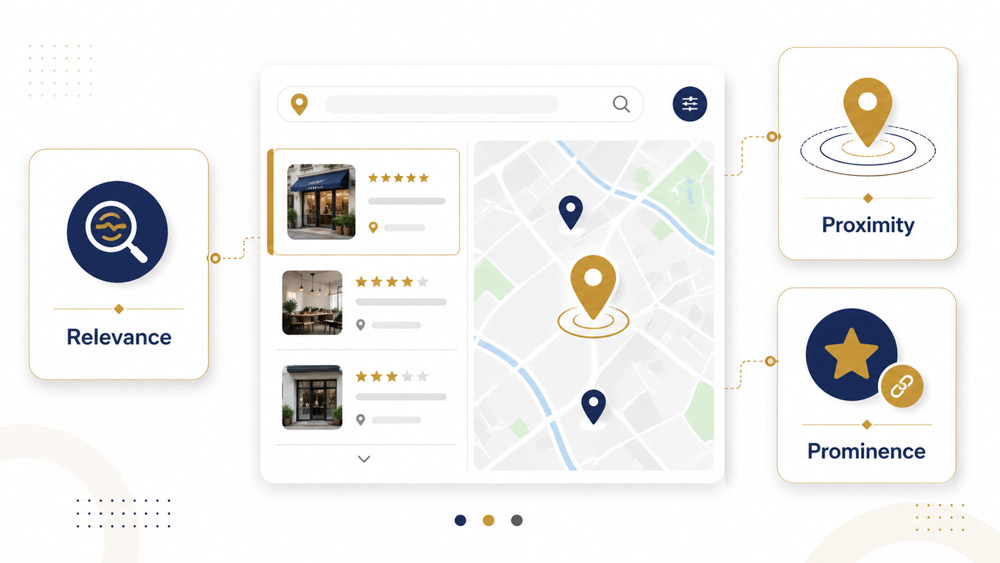
Relevance is how well your business profile matches a user’s search query. If someone searches for “emergency plumber in North York,” Google scans your Google Business Profile, website, and local citations to find businesses that explicitly mention these services and this location. This requires meticulous optimisation of your online assets to ensure the keywords your customers use are present and correctly categorised. A profile that lists “plumbing services” is good; a profile that details “24/7 emergency plumbing repair in North York” is better.
Prominence refers to how well-known your business is, both online and offline. Google measures this through several signals, including the quantity and quality of links pointing to your website from other local sites, the number and average rating of your online reviews, and the consistency of your business information across the web. A business frequently mentioned by local Toronto blogs, listed in directories like Yellow Pages Canada, and holding a 4.8-star rating from 150 reviews is considered more prominent than a competitor with a minimal online footprint. For 2026, Google’s AI-driven updates place even greater emphasis on authentic signals of authority, making a strong online reputation more important than ever.
The Foundation: Google Business Profile (GBP) Optimisation
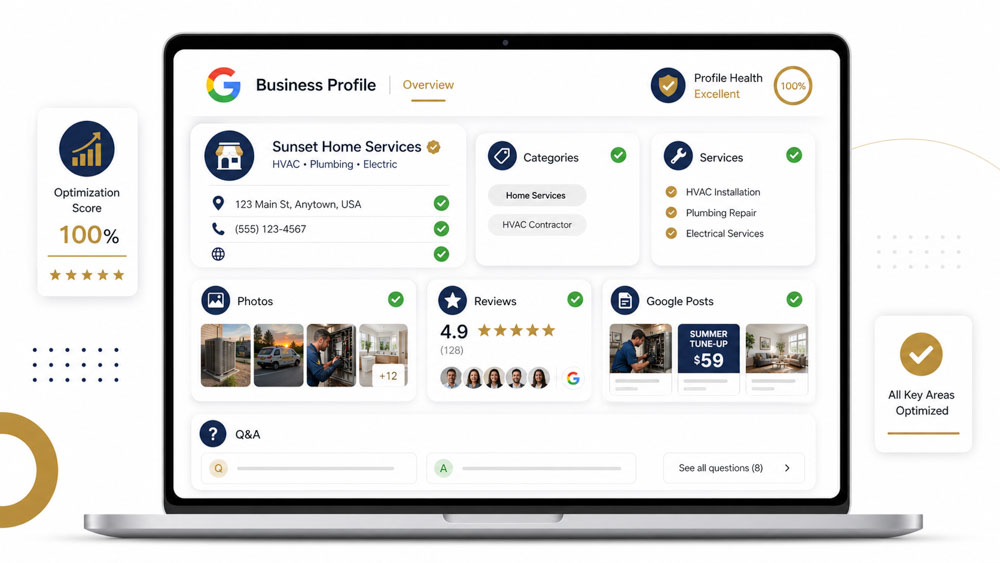
A Google Business Profile is the single most critical asset for local SEO. It is the source of information for the Local Pack and Google Maps, and it often serves as a potential customer’s first interaction with your brand. A neglected or incomplete profile is a significant missed opportunity. A fully optimised profile, however, acts as a powerful customer acquisition tool. At CiCon Marketing, we have seen clients increase inbound calls by over 50% within three months of a comprehensive GBP optimisation alone. The process requires attention to detail across several key areas.
Complete and Accurate Information
Your business name, address, and phone number (NAP) must be perfectly consistent across your GBP, your website, and all other online directories. Any discrepancy, such as using “St.” on one platform and “Street” on another, can confuse search engines and erode trust. Beyond NAP, ensure every possible field in your profile is completed: select all relevant business categories (primary and secondary), add your service areas, define your hours of operation, and list specific attributes like “wheelchair accessible entrance” or “online appointments.” According to Moz, complete and accurate category associations are a top-five ranking factor.
Services, Products, and Media
Use the “Services” and “Products” sections to detail exactly what you offer. Instead of a single entry for “Marketing Services,” create individual entries for “Paid Advertising,” “AI SEO,” and “Local SEO Optimization,” each with a full description and even pricing. This provides Google with specific keywords to rank you for. High-quality media is equally important. Upload recent, high-resolution photos and videos of your location, your team, and your work. Data shows that businesses with more than 100 photos on their GBP get 520% more calls and 2,717% more direction requests than the average business.
Google Posts and Q&A
Google Posts are mini-articles or updates that appear directly on your business profile, ideal for promoting special offers, events, or new blog content. Consistently publishing posts (at least once a week) signals to Google that your business is active. The Q&A section is a user-generated feature, but you can and should proactively populate it. Prepare a list of your most common customer questions and post both the questions and the answers yourself. This allows you to control the narrative and provide valuable information upfront, reducing friction for potential customers.
Building Local Authority Beyond Your GBP
While your Google Business Profile is the centrepiece, a successful local SEO strategy extends beyond it to build widespread credibility. This involves on-page SEO, local link building, and managing your online reputation. These off-profile signals reinforce your prominence and relevance, helping you stand out in competitive GTA markets like downtown Toronto or Markham where hundreds of businesses may be competing for the same Local Pack spots. A strong external signal profile validates the information on your GBP and demonstrates to Google that your business is an established part of the local community.
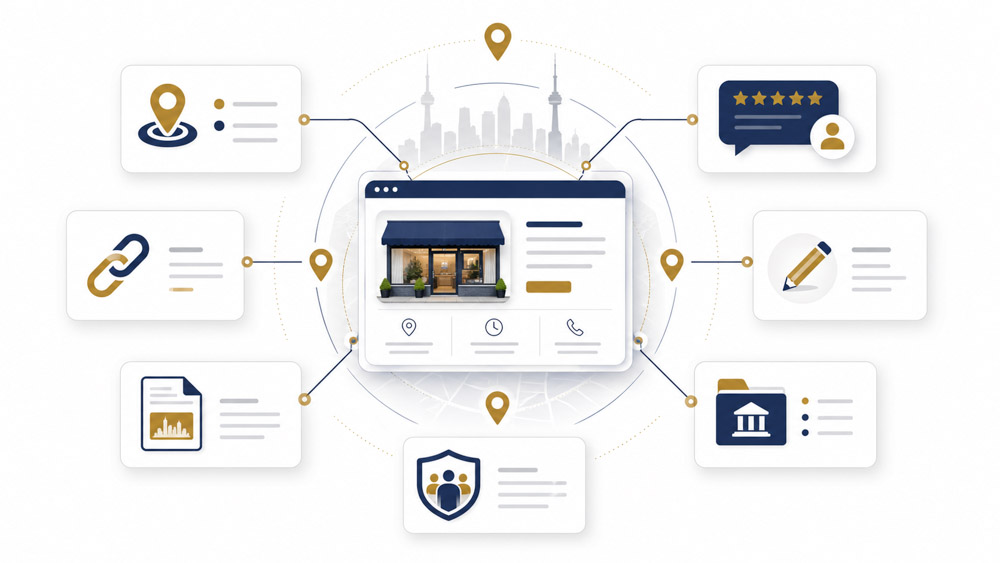
On-page SEO for local businesses means optimising your website content to reflect your geographic focus. This includes creating separate pages for each of your physical locations or primary service areas. For example, a roofing company serving the GTA should have distinct pages for “Roofing Services in Vaughan,” “Roof Repair in Richmond Hill,” and “New Roof Installation in Thornhill.” These pages should contain unique content relevant to that specific area. Additionally, your website’s footer should clearly display your NAP information, and you should embed a Google Map of your location on your contact page. These elements provide clear geographic signals to search engine crawlers.
Local link building is the process of acquiring hyperlinks from other websites within your geographic area. A link from the Richmond Hill Board of Trade or a blog about things to do in Vaughan carries more weight for local SEO than a generic link from a non-local website. You can earn these links by sponsoring local events, joining business associations, or offering scholarships to local schools. Another effective tactic is managing local citations—mentions of your business’s NAP on directory sites like Yelp, CanadaOne, and industry-specific portals. Using a service to ensure this information is consistent across dozens of directories is a foundational step in building local authority.
Local SEO Factor | Weak Profile Example | Strong Profile Example |
|---|---|---|
On-Page SEO | A single “Contact Us” page with one address. | Dedicated service pages for each GTA city (e.g., “Markham Landscaping”). |
Local Citations | NAP listed on 5 directories with inconsistencies. | NAP listed consistently on 50+ relevant local and industry directories. |
Local Links | No links from other local businesses or organizations. | Links from the local Chamber of Commerce, event sponsorships, and community blogs. |
Review Management | 15 reviews, 3.5-star average, no owner responses. | 100+ reviews, 4.7-star average, with thoughtful owner responses to all reviews. |
Measuring Local SEO Success in the GTA
Effective digital marketing requires measurement. Without tracking key performance indicators (KPIs), it is impossible to determine what is working or calculate your return on investment. For local SEO, success is not just about ranking number one; it is about generating measurable business outcomes. The goal is to connect your optimisation efforts to increases in leads, calls, and foot traffic. This data-driven approach allows for continuous improvement and demonstrates the tangible value of your marketing spend.
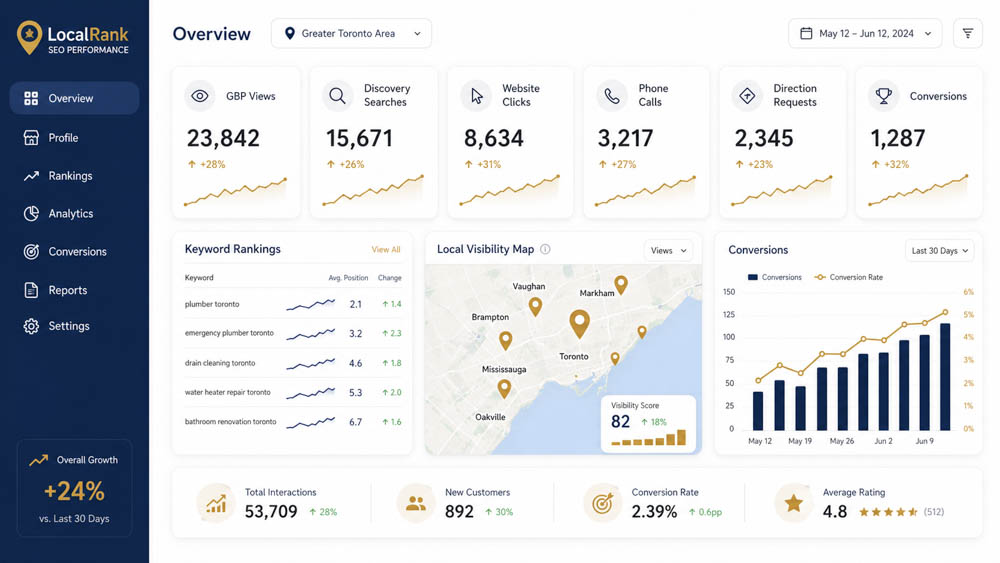
Your primary source of data will be Google Business Profile Insights. This dashboard provides direct metrics on how customers find and interact with your profile. Key metrics to monitor include:
Search Views: How many times your profile appeared in search results.
Direct vs. Discovery Searches: The split between users searching for your business name (Direct) versus a category, product, or service you offer (Discovery). Growth in Discovery searches is a strong indicator of successful SEO.
User Actions: The total number of website clicks, direction requests, and phone calls originating from your GBP. A month-over-month increase in these actions is a direct measure of ROI.
Beyond GBP Insights, use rank tracking software like SE Ranking or Ahrefs to monitor your keyword positions for specific geographic queries (e.g., “dental clinic richmond hill”). Tracking these rankings over time shows the direct impact of your SEO efforts on visibility. It is also crucial to have proper conversion tracking set up on your website through Google Analytics 4. This allows you to see how many users who arrived from an organic search (including your GBP) went on to fill out a contact form, make a purchase, or complete another desired action. By connecting these data points, you can build a complete picture of how local SEO is driving business growth.
Frequently Asked Questions
1. How long does local SEO take to show results in Toronto?
While some improvements, like GBP optimisation, can yield results within 60-90 days, achieving competitive rankings in a dense market like Toronto typically takes 6 to 12 months. The timeline depends on your industry’s competitiveness, your starting point, and the consistency of the effort.
2. What is the biggest mistake GTA businesses make with local SEO?
The most common mistake is inconsistent NAP (Name, Address, Phone number) information across different online directories. These inconsistencies confuse search engines and erode the trust needed to rank your business as a reliable local entity.
3. Is local SEO a one-time task?
No, local SEO is an ongoing process. Competitors are constantly working to improve their rankings, and Google’s algorithm is always evolving. Consistent effort in acquiring new reviews, publishing content, and building local links is necessary to maintain and improve your position.
4. How much does local SEO cost for a business in the GTA?
Costs can vary widely based on the scope of work and competitiveness of the market. A basic monthly retainer for a small business in a less competitive suburb might start around $1,000, while a comprehensive campaign in downtown Toronto could be $3,000 or more per month. Be wary of agencies offering guaranteed results for a very low price.
5. Do I need a physical address in a city to rank there?
For the Local Pack, a verified physical address in the city is generally required. Service-area businesses that travel to customers can hide their address, but their ranking potential is still highest in the city where their business is registered. You cannot use a P.O. box or virtual office to rank in a city you are not physically located in.
6. How do customer reviews affect my local ranking?
Customer reviews are a significant ranking factor. Google uses the quantity, velocity (how frequently you get them), and overall rating of reviews to gauge your business’s prominence and trustworthiness. Responding to reviews is also a positive signal.
Final Recommendation
For a Greater Toronto Area business seeking to improve its local search visibility in 2026, the most impactful starting point is a comprehensive audit and optimisation of its Google Business Profile. This single action addresses the foundational elements of relevance and prominence that Google’s algorithm prioritises. Completing every profile section, uploading high-quality media, defining all services, and establishing a process for acquiring reviews can produce measurable gains in calls and website clicks within 90 days.
While broader strategies like link building and on-page SEO are essential for long-term dominance, mastering your GBP provides the quickest path to tangible results. It is the lowest-hanging fruit and the highest-impact activity for any local business. Do not delay; your competitors are already optimising their profiles.
Schedule Your Free Strategy Call
Take the first step towards dominating local search in your market. Contact CiCon Marketing for a no-obligation consultation to identify your specific opportunities for growth.
About the Author — Majid Behzad, Founder & Senior Digital Marketing Strategist
Majid Behzad is the founder of CiCon Marketing with over 15 years of experience in digital marketing and media production. A Google-certified specialist with a Master’s in Engineering and a Postgraduate degree in Marketing Management, Majid combines technical precision with data-driven strategy to help GTA businesses achieve measurable growth. Connect with him on LinkedIn or Instagram. Learn more at cicon.ca/about-us/.