
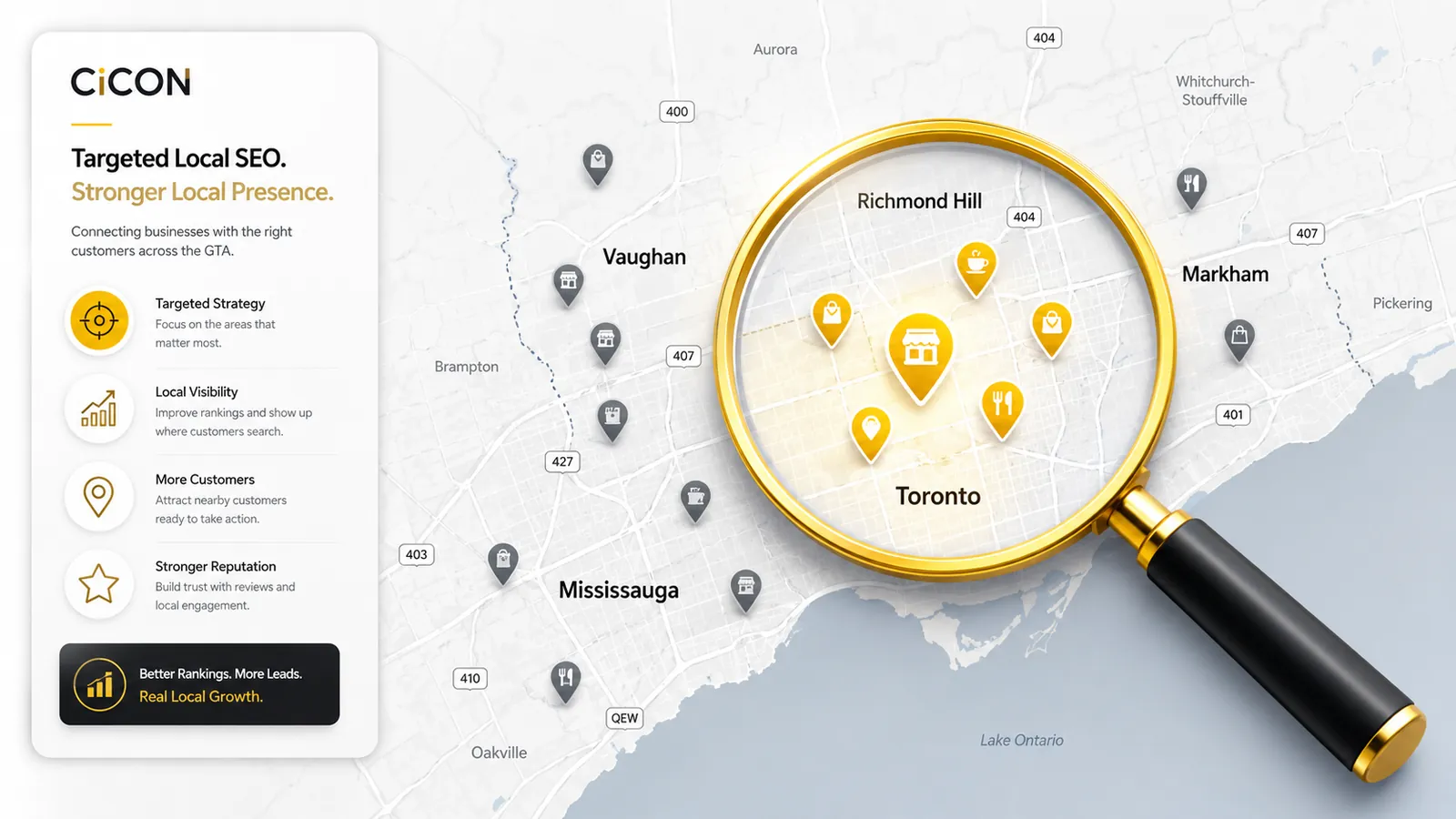
Making local SEO work without wasting your budget requires a shift from broad activities to precise, high-impact actions. Concentrate on three core areas: your Google Business Profile, hyper-local content, and earning high-authority local backlinks. This data-driven approach moves away from vanity metrics toward measurable customer acquisition for businesses in Richmond Hill, Vaughan, and the wider GTA. CiCon's local SEO services are built on exactly this framework.
Many business owners are justifiably skeptical of SEO after investing in strategies that yielded no tangible results. The common failure point is a focus on outdated tactics that do not align with how Google's algorithms evaluate local businesses today. A successful strategy is not about being listed everywhere — it is about being authoritative where it matters most to your potential customers. CiCon Marketing has applied this principle across over 250 GTA projects.
The Foundational Mistake: Where Most Local SEO Budgets Are Wasted
The most significant waste in local SEO spending comes from paying for low-impact, high-volume activities that create an illusion of progress. Many agencies sell the idea that submitting your business to hundreds of online directories is the key to success. While citation consistency is a minor ranking factor, its importance has diminished significantly. In 2026, paying hundreds of dollars for automated submissions to obscure directories is a poor use of funds. A single high-quality backlink from a local newspaper will have a greater impact than 200 generic directory listings.
of all local search clicks go to the top 3 results in the Google Map Pack — making Map Pack visibility the highest-ROI target for local budgets
Local SEO industry research, 2026
Platforms like Yext or Moz Local can be useful for large, multi-location enterprises. However, for an SMB serving Markham or North York, the return is minimal. The budget is better spent on activities that directly influence your visibility in the Google Map Pack, where the majority of local conversions happen.
Another common budget drain is an overemphasis on broad, non-local keywords. A contractor in Scarborough does not need to rank across Canada for "home renovations" — they need to rank in Scarborough and surrounding neighbourhoods. Focusing on vanity keywords without local intent leads to irrelevant traffic that does not convert. A successful strategy prioritises hyper-local terms within a defined service area, which is exactly what Google's local algorithm is designed to reward.
Budget Allocation: The 70/20/10 Rule for Local SEO in 2026
To prevent budget waste, a disciplined allocation model is necessary. For most local businesses — from dental clinics in Thornhill to contractors in Toronto — the 70/20/10 rule focuses investment on activities with the highest potential return. This model deliberately moves budget away from low-impact tasks and toward building a defensible local presence that competitors cannot easily replicate.
| Budget Allocation | Percentage | Key Activities | Rationale |
|---|---|---|---|
| GBP & Content | 70% | GBP optimisation (Posts, Q&A, Services, Photos), review acquisition, hyper-local service/location pages. | Directly influences Map Pack rankings and conversions. BrightLocal: 98% of consumers use the internet to find local business information. |
| Technical SEO | 20% | Local business schema, mobile site speed, on-page optimisation, internal linking, NAP consistency check. | Ensures Google can crawl and understand your site's local relevance. A foundational element for content to perform. |
| Link Building | 10% | Manual outreach for local links (sponsorships, community partnerships, local press), targeted citations. | Builds domain authority and local trust signals. Focuses on quality over quantity, avoiding spammy tactics. |
Mastering Your Google Business Profile: The Highest ROI Activity
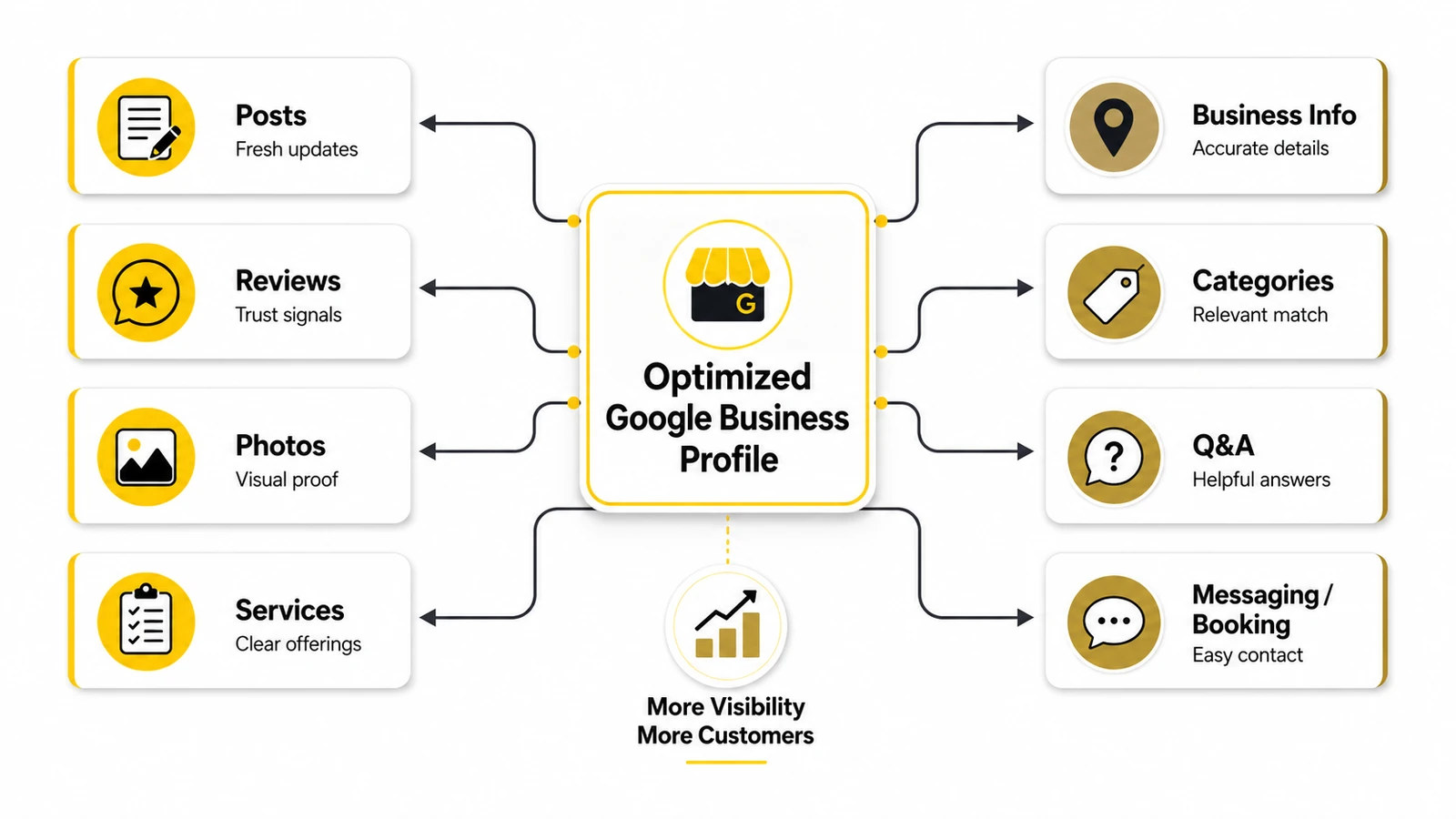
Your Google Business Profile is no longer just a listing — it is a dynamic, interactive platform and the single most critical element of your local SEO strategy. A fully optimised GBP can function as a secondary homepage, driving calls, messages, and foot traffic directly from the search results page. Begin by ensuring every section is complete: detailed service descriptions, pricing if applicable, and at least 20–30 high-resolution photos geotagged to your location. Consistently use the GBP Posts feature to share updates, offers, and news. According to Google's own data, businesses that add photos to their profiles receive 42% more requests for driving directions.
more direction requests received by businesses that add photos to their Google Business Profile
Google Business Profile data
Actively manage the Q&A section by pre-populating it with common customer questions. Enable GBP messaging and respond promptly to inquiries. Most critically, establish a systematic process for generating and responding to reviews — positive reviews are a known ranking factor. A business with a 4.5-star rating and 100+ recent reviews will almost always outperform a competitor with a 3-star rating and 10 outdated reviews.
Creating Content That Ranks Locally
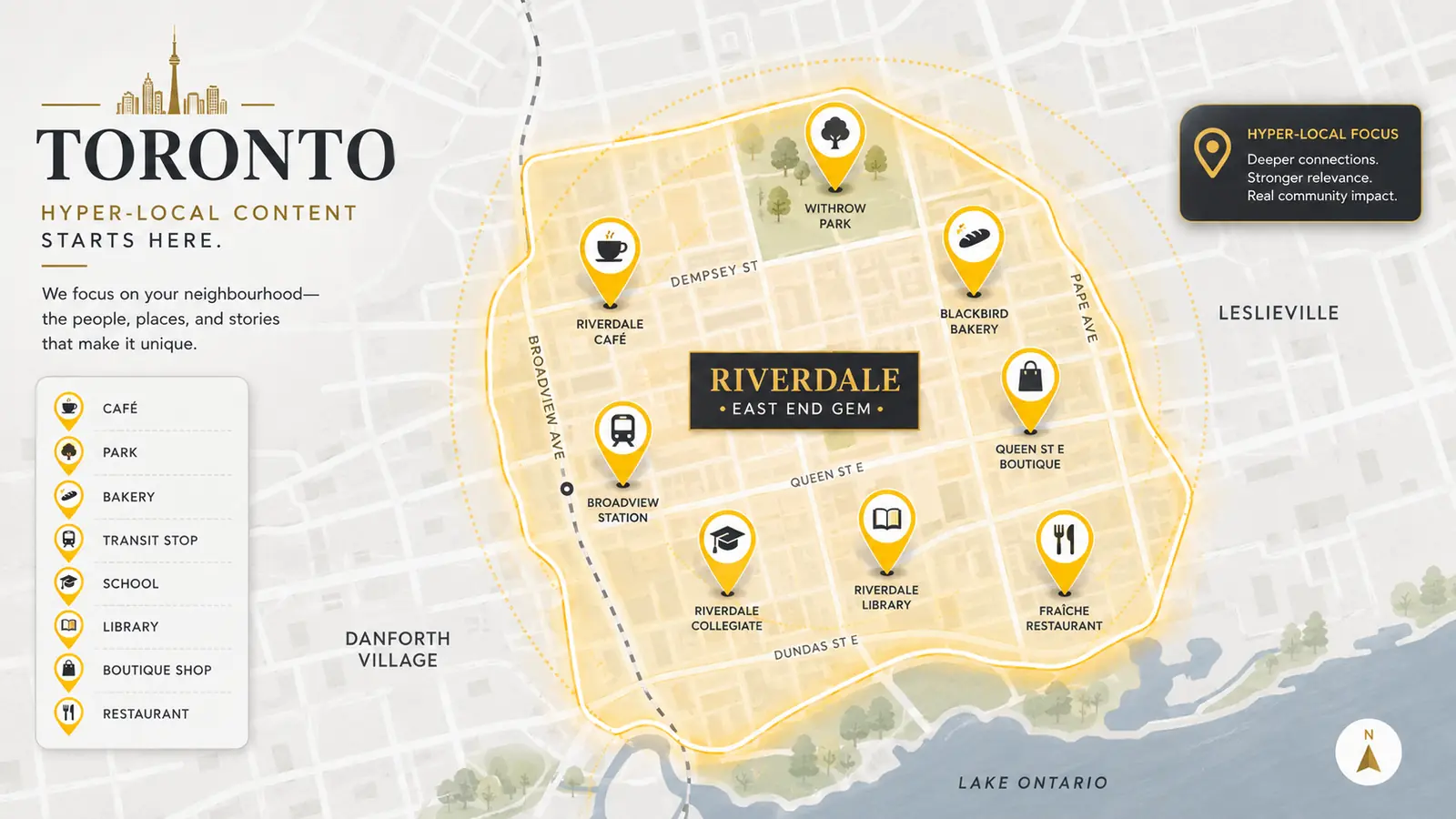
To capture valuable local search traffic, your website content must speak directly to customers in your service area. The goal is to create a network of hyper-local pages that establish your business as the go-to authority in specific neighbourhoods and for specific services. This strategy targets how users actually search — combining a service with a location, such as "emergency plumber North York" — rather than broad, high-competition generic terms.
Develop dedicated landing pages for each core service in each primary location you serve. A page for "SEO services in Vaughan" should be distinct from one for "SEO services in Markham," incorporating locally relevant details, nearby landmarks, and community-specific information. AI-powered SEO tools can help map content gaps across these location pages, ensuring you cover the full search landscape for your service area.
This content strategy helps you rank for valuable long-tail keywords instead of competing for highly competitive terms. For example, instead of "dentist," you can dominate "dental implants near Fairview Mall." This approach attracts users with higher purchase intent. Support it with a strong internal linking structure that distributes authority from broader service pages to these specific, localized pages.

Local Link Building & Citations: Quality Over Quantity
In 2026, the value of local backlinks is determined by quality and relevance, not volume. A single link from the Richmond Hill Board of Trade or a feature in a local Toronto blog carries more weight than hundreds of generic directory listings. Citations — mentions of your Name, Address, and Phone number (NAP) — still matter for foundational consistency. Use a tool like Whitespark to audit and clean up citations on platforms like Apple Maps and Bing Places. Once this foundation is set, shift your focus entirely to manual link building through real-world relationships.
Sponsor a local youth sports team, host a community workshop, or partner with a non-competing local business for a cross-promotion. These activities generate high-quality, relevant backlinks. Avoid services that promise to build hundreds of links for a flat fee — these are almost always low-quality, spammy links that can harm your site's authority. Strategic outreach to local bloggers, community leaders, and business associations builds a defensible moat of local authority that competitors find difficult to replicate.
Measuring What Matters: KPIs Beyond Rankings
Focusing on ranking number one for a keyword is a vanity metric. The ultimate goal of local SEO is to generate business, not just top rankings. Your KPIs must reflect tangible outcomes: increases in qualified leads, phone calls, and store visits. Your primary measurement tools should be Google Business Profile Insights and Google Analytics 4 (GA4). In GBP Insights, track phone calls, direction requests, website clicks, and messages. In GA4, configure conversion tracking for form submissions and phone number clicks from organic search traffic.
It is crucial to differentiate performance by channel. As explored in our analysis of Google Ads vs. SEO for dental marketing in 2026, each channel has unique conversion pathways. Furthermore, AI SEO tools can help map out content gaps and score local authority, giving you a competitive edge in tracking complex KPIs across the GTA market.
Final Recommendation
For a small or medium-sized business in the Greater Toronto Area, the most effective use of a 2026 local SEO budget is to concentrate relentlessly on Google Business Profile optimisation and hyper-local service-in-location content. These two activities deliver the highest and most measurable ROI. Avoid the temptation to spread your budget thin across low-impact directory submissions or broad keyword targeting. CiCon's local SEO optimization services implement exactly this framework for GTA businesses.
Focus on building real local authority by dominating the search results for the specific services you offer in the specific neighbourhoods you serve. This disciplined approach ensures your marketing dollars are invested in building a durable competitive advantage that directly contributes to customer acquisition and measurable business growth.